
 Brett Derricott
AI agents are here. They're already joining the workforce, and organizations are starting to run into a practical question: who owns those agents, and who's accountable for what they do? The honest answer, in most organizations right now, is that nobody knows for certain. It's the wild west. Agents are being spun up across teams faster than anyone is tracking them, and in many cases, the people deploying them have no idea what else is already running.
Every agent that gets deployed has an owner somewhere. Ideally, it has a budget line, an approval, a team that spun it up. Trace that trail in most organizations today, though, and it tends to go cold fast, usually around the time it crosses from IT into HR, or from the pilot team into operations.
That ambiguity matters more as agent adoption accelerates. Deloitte predicted that in 2025, 1 in 4 companies currently using generative AI would launch agentic AI pilots or proofs of concept, with adoption expected to reach 50% by 2027. Within the next few years, roughly half of all organizations will have autonomous systems making decisions and operating alongside their human workforce, in many cases before anyone has worked out who owns them, who tracks them, or what they're actually authorized to do.
The org chart was designed around humans: how many people are in a role and who they report to.
The people-centric org chart has always had limitations, and a more significant problem now is that it was never really designed around the work itself. It was designed around the people doing the work, so when the resource doing the work isn't a person, the typical org chart fails.
AI agents don't show up in your HRIS (and no, the answer isn't to add them as a new category of "employee" record), and they don't have a salary band. They don't belong to a department in any formal sense, even when they're doing departmental work every day. They don't appear in a headcount plan, yet they create real operating costs. They work inside your organization, yet the systems you use to govern your organization may have no record of them.
There's a structural tension most organizations haven't fully resolved yet: data governance has traditionally belonged to the CIO, and workforce governance has traditionally belonged to HR. AI agents sit in both worlds at once.
When an agent is provisioned, IT typically owns it: the infrastructure, the access, the security protocols. When that agent starts doing work that affects people, structure, and planning decisions, it starts operating in territory that HR is supposed to own. Who authorized it to take that action? Who reviews what it's doing? Who updates its scope when the org changes? Who retires it when it's no longer needed?
Most organizations are answering these questions informally, if at all. Someone in the IT department made a call, someone in HR wasn't involved, and now there's an agent operating with real organizational authority, influencing decisions about talent, structure, or headcount, without a clear chain of accountability.
Deloitte notes that making agentic AI work requires early alignment across IT, HR, finance, and operations before implementation, not after. The cost of waiting isn't just untangling decisions; it's the data errors, unauthorized actions, and accountability gaps that accumulate without clear oversight or accountability.
The challenge isn't just structural. It's also functional.
HR was built to manage humans: to handle the hiring, development, and offboarding of people. The function is organized around the employee record, the employment relationship, and the obligations that come with managing a person.
The workforce HR is now being asked to govern is no longer exclusively human, though. Agents are doing real work, handling tasks that used to belong to people, operating within teams, and making decisions that have downstream consequences for the organization. Someone needs to be accountable for these agents, someone needs to track them, and someone needs to ensure they're doing what they were authorized to do.
Workforce governance is historically HR's job, yet HR's tools, systems, and frameworks were built for a workforce made up entirely of people. The function may need to evolve toward something closer to a broader resources model, one that owns governance of all the resources doing work in the organization, human or otherwise. Companies that start thinking about that now will likely be better positioned than the ones waiting for a more pressing reason to have the conversation.
Most HRIS systems were built around the person. The employee record is the fundamental unit, and everything else points back to it, which made sense when every resource doing work was a human with an employment relationship.
A person-centered data model has a harder time answering what happens when the resource isn't a person, though. When someone leaves, a person-centered system archives the employee and the position disappears with them. The org chart loses the position, the reporting lines break, and the budget, history, and context of the position go with them. To reconstruct what that position required, who it reported to, and what it was authorized to do, you're usually working from memory and old spreadsheets.
With human headcount, this is already a meaningful gap. With AI agents, it becomes even harder to manage: agents don't have employee records, they don't terminate in the HRIS, and they don't leave a clean trail. In a person-centered system, they don't have anywhere to live at all.
A position-centered model handles this differently. A position defines the work, the accountability structure, and the authorization logic, independent of who or what fills it. It exists whether it's occupied by a person, an agent, or left open, and it stays in place when the occupant changes. In a position-centric model, a position can even be shared by both a human and an agent, representing a shared responsibility. At Built, we actually do this today. Our org health agent—currently in beta—flags open positions, span-of-control issues, and structural gaps, governed through the same position-based model as the rest of the org chart.
Built was designed around this model from the start, not specifically in response to AI agents, but because the work itself should anchor the data. When someone leaves, the responsibilities, reporting structure, budget, and organizational context tied to that position still remain.
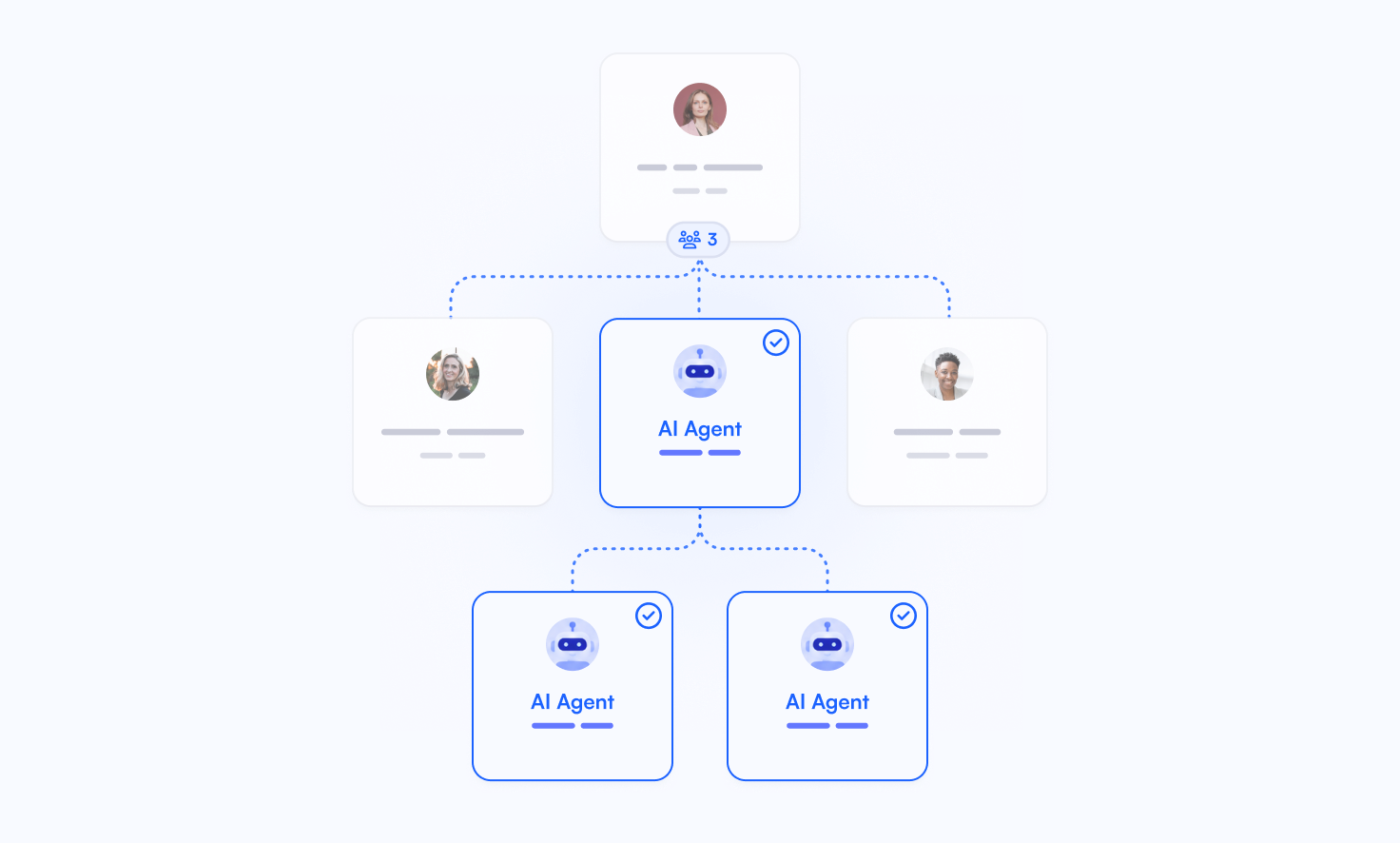
A position can hold an AI agent the same way it holds a person. An agent can sit on the org chart, carry authorization logic, report through a management chain, and be governed the same way any other resource in the organization is governed, which gives the question of who owns the agent, who can change its scope, and who is accountable for its actions a clear structural answer.
The frameworks for governing AI in the workforce are still evolving. Most organizations are still working out basic questions around ownership, oversight, and accountability.
The agents, meanwhile, are already showing up. Teams are provisioning them in pilots and production environments, often without a clear system for tracking where they operate, who manages them, or what authority they actually have. If there is a system, it's probably a spreadsheet.
By the time many organizations formalize governance around AI agents, agents will already be embedded in real workflows, influencing hiring, planning, approvals, and operational decisions across the business. The organizations best equipped to handle that shift will be the ones with systems designed around structure, accountability, and visibility from the beginning.
Learn how position-based architecture can help you with AI governance. .
Schedule a brief, no-pressure call with a product expert.